An admissions coaching session needs to give a staff member something specific to practice. A useful note might say, “The caller asked when they would hear back. You explained what would happen next and named who would follow up, then recorded the same owner in the practice record.” Each part of that observation can be seen, checked, and repeated.
Use the rubric below with live, fictional role-play. It focuses on administrative conversation skills such as responding to a question about an imaginary information session, checking approved office information, and handing off a follow-up. The trainer supplies every detail. The exercise uses no real callers, patient information, call recordings, or active admissions records.
Give each participant a short scenario card
Choose one administrative question for the participant to answer. For example, a fictional visitor asks whether a practice program offers an evening information session and where the meeting would take place. The staff card confirms only the daytime schedule and the location of the main office. It identifies the imaginary scheduling coordinator as the person who can check whether another session exists.
Give the role-playing caller a separate card. It tells them the two questions they are supposed to ask, when to ask a follow-up, and how to respond if the participant checks their understanding. A realistic follow-up might be, “So should I plan to go to the main office after work?” The caller should use the same facts for each participant and avoid inventing a new deadline or location halfway through the exercise.
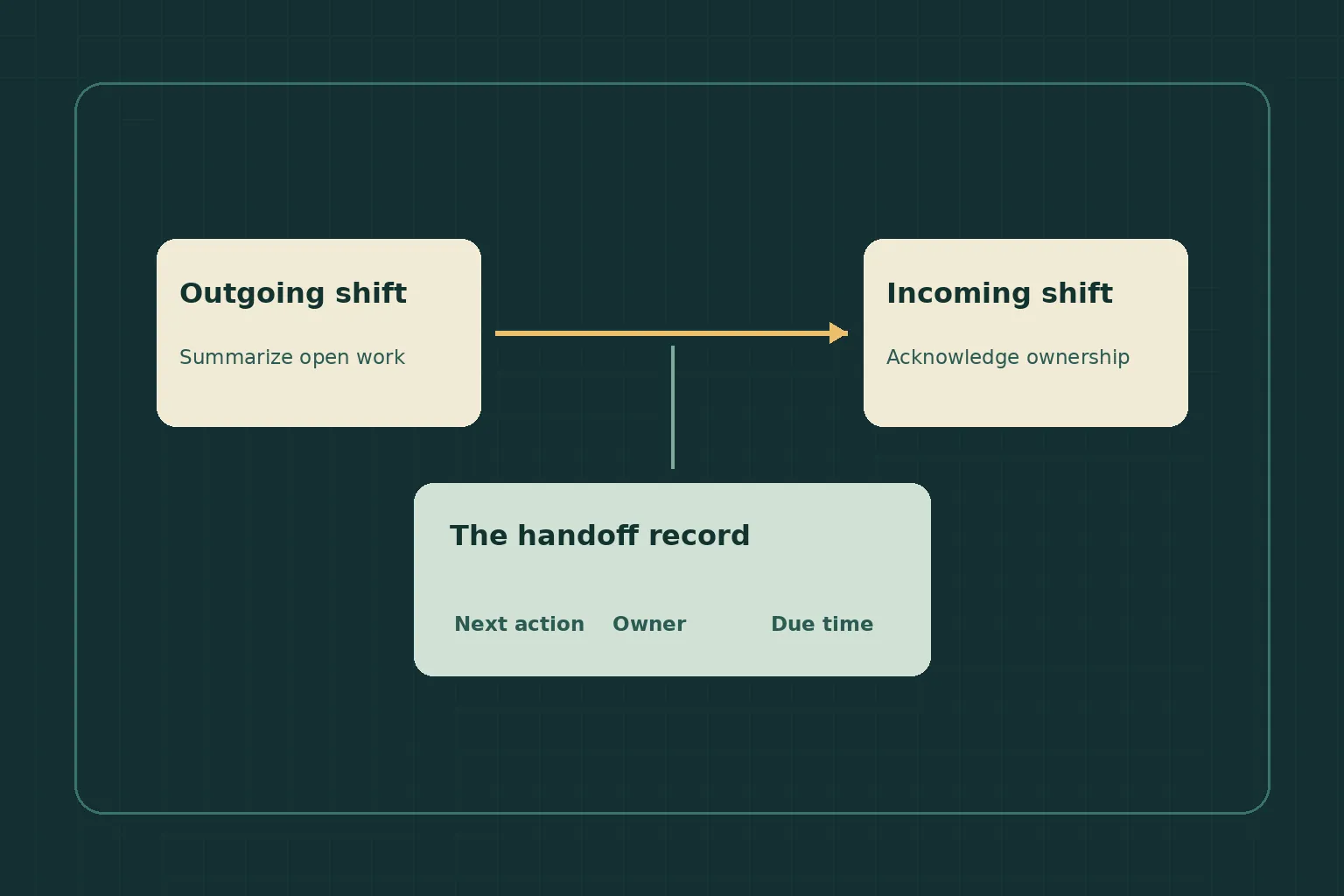
The observer needs the same fact card as the participant and a copy of the scoring guide. If the exercise includes a handoff, set up a blank practice entry with fields for next action, owner, and agreed timing. A sheet marked “training example” is enough for a tabletop exercise. The point is to check whether the participant can carry the agreement into a fictional record.
Alliance’s admissions team training and coaching overview describes how managers can reinforce inquiry handling and follow-up through practice. The narrow scenario here lets a coach see which action needs work before asking the team to practice a more complex conversation.
Score five behaviors the observer can see
Use three marks: observed, missed, and not applicable. Mark observed when the participant demonstrates the defined action. Mark missed when the prompt creates a clear opportunity and the action is absent or incomplete. Mark not applicable when the scenario offers no opportunity to demonstrate that behavior. Agree on applicable rows while preparing the prompt.
| Behavior | What earns an observed mark | Example coaching note |
|---|---|---|
| Clarifies the question | Summarizes the request and gives the caller a chance to confirm it | “Restated both the time and location questions, then paused for confirmation.” |
| Uses verified information | Uses only the administrative facts supplied for the exercise and keeps those facts tied to the right event | “Correctly gave the daytime location. Kept the evening location unconfirmed.” |
| Names uncertainty | Identifies which detail needs checking and explains the approved route for that check | “Said the evening schedule was unconfirmed and named the scheduling coordinator.” |
| Agrees on the next step | States the action and its owner before closing, and mentions timing when it has been agreed | “Named the scheduling coordinator and described the question that person would check.” |
| Records ownership | Enters the same action, owner, and agreed timing in the practice record | “Record included the schedule check and owner. No timing was entered because none was agreed.” |
Write one short note beside each mark when the coach will use it in feedback. Capture the action or a short invented phrase from the exercise. A statement such as “was friendly” gives the participant little direction. “Asked the caller to confirm which session they meant” points to a behavior someone else could recognize in a second round.
Keep the rows separate. A participant can accurately state which schedule is confirmed and still leave the caller unclear about who will check a different date. Likewise, a participant may close with a clear next step and then leave the owner field blank. Mark the distinct behaviors so the coach knows whether to practice the close, the written follow-through, or both. Alliance’s call monitoring, scoring and quality assurance page describes how scoring definitions can help managers connect observations to practical coaching.
Prepare two fictional prompts with the same scoring opportunities
For the first round, use the daytime and evening schedule question. For a second prompt, use an imaginary visitor who asks whether an information packet will be available at an off-site event. The fact card confirms that packets are available at the office. It leaves the off-site supply unconfirmed and names the fictional event coordinator as the contact who can check.
Both prompts give the participant a reason to clarify the question, explain what the supplied facts support, name what still needs checking, agree on a next step, and record its owner. The details differ enough to see whether the participant can use the skill when the contact role or question changes. Keep the participant’s fact card available throughout. The exercise examines how someone works with a known source, so requiring memorization would measure a different task.
Write a simple branch for the role-playing caller. If the participant asks whether they mean the daytime session or the evening option, the caller confirms the evening option. If the participant asks what matters most, the caller says time comes first, then location. If the participant proposes a schedule check, the caller can acknowledge the next step without requesting a promise. Put these cues on the card so everyone has a comparable chance to demonstrate the same behaviors.
For a final variation, remove the uncertainty from the scenario and give the participant a fully confirmed office hour. The observer can then score whether the participant relays it accurately. The uncertainty row becomes inapplicable unless the caller introduces a question the scenario deliberately leaves open. Watch for a participant asking for a follow-up when the supplied answer already resolves the question. The observer can describe that choice without penalizing a row that had no opportunity. Keeping the two versions labeled helps the trainer distinguish a weak response from a scenario that simply called for a shorter conversation.
Leave any actual operating question outside the exercise. If a participant asks what happens at their own organization under similar circumstances, the trainer can note the question for the relevant process owner. Keep scoring anchored to the fictional facts until that separate question is resolved.
Calibrate the observer marks before giving feedback
Have two observers watch the same short practice round when practical. Each observer scores the five rows independently. Then compare the marks and ask each person to point to the action that supports their score. The aim is to resolve differences in what counts as evidence.
Imagine the participant closes by saying, “We’ll look into it.” One observer marks the next step observed because a check was mentioned. The second marks it missed because the speaker used “we” without identifying an owner. The definition calls for an action and its owner, so this example belongs under missed. The note can say, “Promised a check but left the responsible role unnamed.” An observer can then apply the same rule if another participant uses a different phrase.
A disagreement can also expose an unclear prompt. If the fact card provides no role that can accept the question, the participant may have no fair opportunity to identify the owner. Revise the card and replay the prompt before taking a mark from that setup as useful evidence. A coaching worksheet can also include a separate line for “scenario issue” so a missing instruction does not reappear as a staff coaching note.
Alliance’s admissions scripts and communication training page is relevant when staff guidance needs clearer language about what to confirm and which role takes the next step. Coaches can teach the components of a handoff while letting people use natural wording.
Give one coaching instruction and run another round
Suppose the participant gives the verified schedule and names uncertainty correctly. The next-step row is missed because they close with a general promise that someone will be in touch. Start with an action they completed, give the specific gap, and ask them to try a concrete change.
For example: “You checked which time the visitor needed and kept the evening schedule open. In your close, say who will check it and what that person needs to confirm.” Use a practice line such as, “The scheduling coordinator will check whether there is an evening session and which location applies.” The participant can add timing if the fictional prompt supplies an agreed time. Avoid adding a deadline merely to make the sentence sound complete.
After quick practice using the original scenario, give the second fictional prompt. Let the person read its fact card and complete the exercise without a cue from the observer. Score with the same definitions. If the participant names the event coordinator and records that role in the practice entry, the observer can mark both actions observed for that round. If the spoken close is clear but the entry has no owner, shift the next practice toward recording ownership.
This sequence gives the trainer something more useful than a combined score: a description of the behavior that appeared, the prompt where it appeared, and what still needed help. The admissions and revenue growth overview places staff coaching alongside workflow and follow-up work. The practice result here can help a manager decide which of those administrative questions to look at next.
Keep coaching and workflow questions visible
A missed action can point to the practice material or to the workflow the participant was asked to simulate. For example, a fictional next action might say “send the event question to operations,” but the practice form lists two operations roles and neither is defined as the owner. Ask an appropriate workflow owner to review the example before coaching the staff member on which field to choose. A role the exercise never defined is an issue with the setup.
Keep one short summary per exercise. A coach can note the scenario, the behavior practiced, the marked result, and what the person will try next. A small team training summary might say, “Three participants completed the scenario. Two named the follow-up owner without help. One needed clarification about the training form’s owner field.” Those invented counts illustrate the format. For an actual training session, the resulting notes describe the exercise only. They provide no measure of real calls, enrollment outcomes, or clinical performance.
If you later refine the rubric, record what changed before comparing practice rounds. Splitting one row into two or adding a required time field changes the criteria. Keep the prompt and the definitions steady when you want to see whether a particular coaching instruction helps someone demonstrate one action. Change the prompt when you want to see whether the participant can apply the same skill to a new administrative question.
Finish the session by asking what the participant would check next time they face a similar practice question. A strong answer can be simple: find the approved administrative fact, say what still needs checking, name who will act, and carry the agreement into the training entry. The coach then has a focused behavior to revisit in the next practice round.