An admissions coordinator makes an agreed callback and gets no answer. The call log can tell the team when the attempt happened. The admissions record still needs to tell the team what that attempt means for the open work. If the record simply says “left message” or “try later,” another coordinator may be unable to tell whether anything remains assigned.
Use this worksheet to record an unanswered callback, make an administrative decision visible, and show when that step is complete. The examples use invented records and work labels. Apply the team’s established process for deciding how to handle contact instructions, additional actions, and exceptions.
Record the event before changing the status
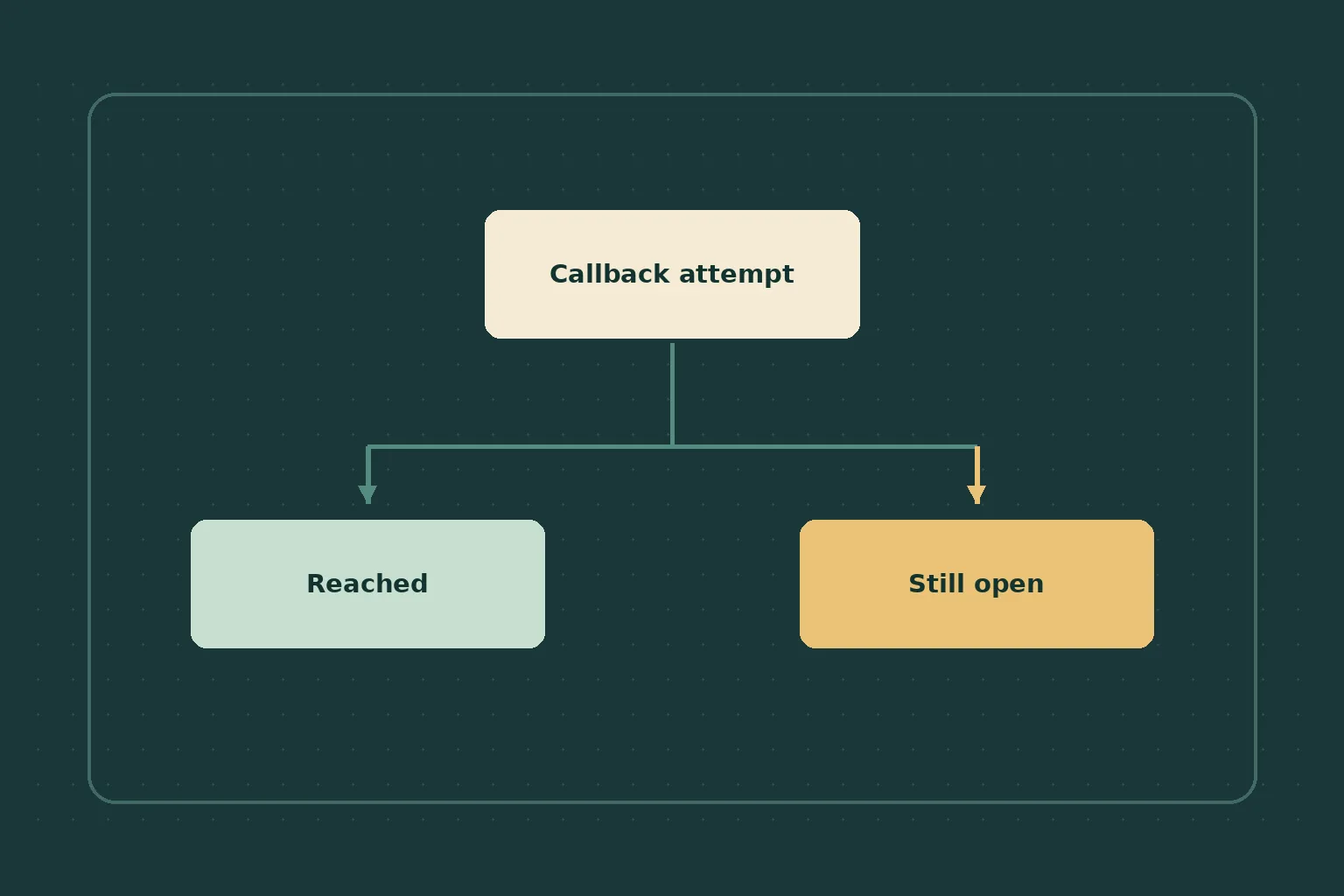
Start with the observable outcome. Enter when the call was placed and what happened on the route used. If it rang without an answer, record that outcome. If a message was left in accordance with the recorded instructions, document the completed action in the appropriate part of the record. Neither result confirms a conversation. A short factual description gives the next coordinator something to verify if the call log and work queue disagree.
Use separate fields for the latest attempt and the current work status. The latest result could be “no answer at agreed callback.” The work status could be “instructions review pending” or “administrative follow-up closed,” depending on the team’s existing process and what the record supports. Putting those statements in separate fields keeps a single event from becoming a conclusion about the broader request.
For example, a coordinator might close the work item because the team’s established procedure identifies a stopping point. The last call still had no answer. There is no need to change the attempt outcome to “declined” to remove it from the active queue. If a staff member later receives an inbound request, that new event can be documented on its own merits. This distinction is useful when reviewing lead management and follow-up systems and the labels they make available.
Make the administrative decision visible
| Observed result in a fictional record | Suggested attempt label | Administrative decision to capture |
|---|---|---|
| The recorded number rang without an answer | Attempt did not connect | Identify the next step the established workflow calls for or record why the item is closed |
| The recorded instructions are unclear when staff review the attempt | Instructions need review | Identify the reviewer and the instruction they need to clarify |
| The number connects to a different recipient or appears to be wrong | Route needs verification | Assign the established exception review and note which route is in question |
| A person gives an explicit instruction to stop outreach | Contact declined | Record the stated instruction through the team’s established procedure |
| Staff and the intended recipient speak and confirm a next administrative step | Connected | Record the outcome and identify any resulting work separately |
Choose a label that matches the available evidence. A missed call tells you about that attempt. An explicit instruction tells you something different. “No answer” and “declined” can both end up near the bottom of a queue, but they have different meanings if someone later reviews the record or receives a new inquiry.
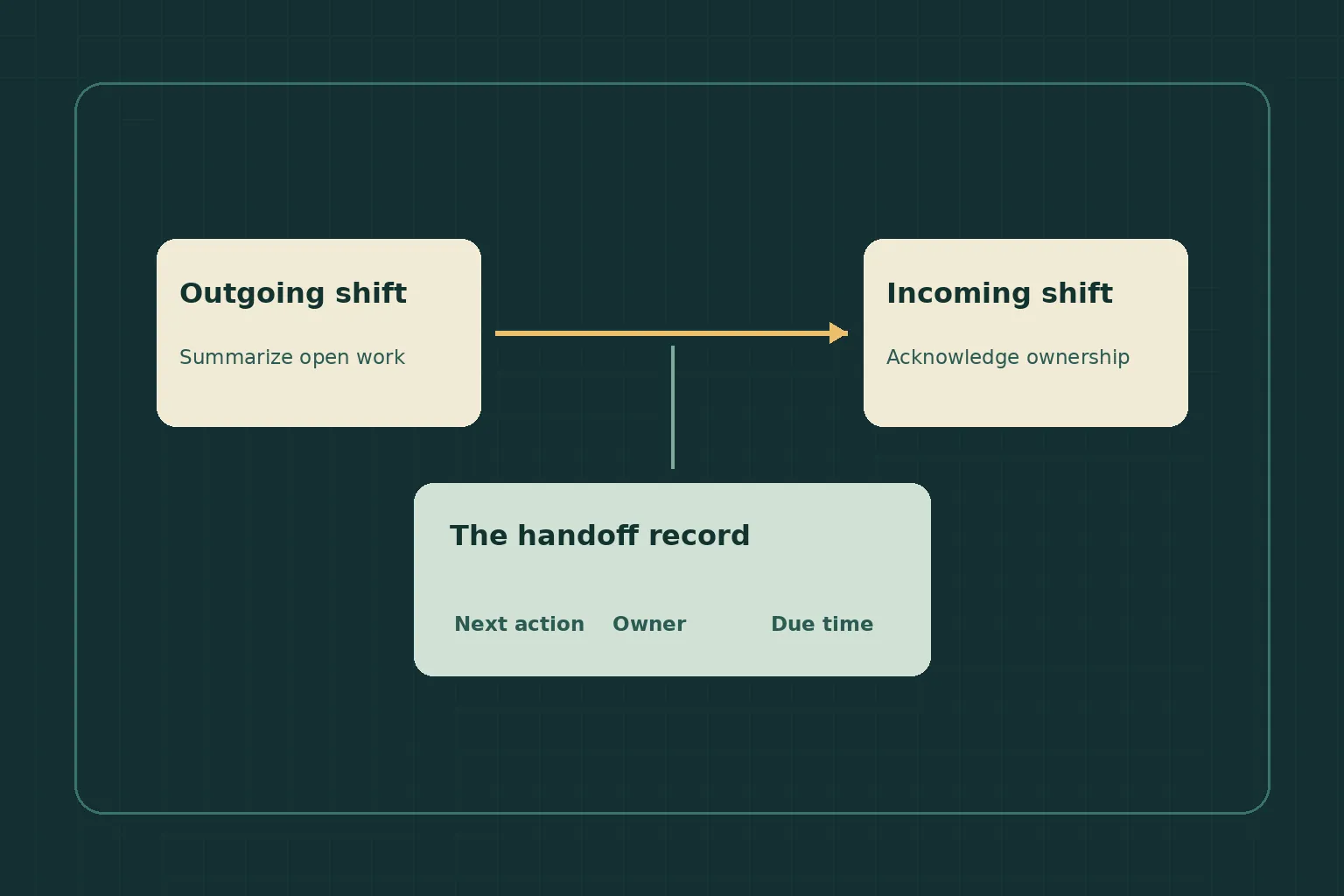
When the current instructions are unclear, write what needs to be resolved rather than a vague note like “needs follow-up.” For example, “Queue lead to confirm whether the callback instruction in the admissions record is current” gives the reviewer a concrete question. The due time comes from the team’s workflow or the existing commitment. It does not have to be a new callback time. Sometimes the next administrative action is clarifying the instructions or recording a closing decision. Teams refining the words staff use at this step can refer to admissions scripts and communication training.
Use one owner for each unresolved decision
An unanswered callback may leave a decision open even when the attempt itself is complete. Name one person who owns that decision. If a staffed role owns it, identify who holds that role for the relevant period. A role label with no staffed coverage can leave work apparently assigned while nobody knows to act.
Enter a short question the owner can answer, such as “Do the documented instructions identify a next step?” Give the owner the record reference and any relevant time already established by the team. If the answer creates a new action, give that action its own status. A closed decision and an open action can exist on the same inquiry without contradicting each other.
A useful check is whether the team could distinguish a due review from a due callback in the queue. A generic “callback pending” label can create the impression that someone owes another call. If the unresolved item is actually an instruction review, name it that way. Once the reviewer makes the decision, close the review task and show the disposition it produced.
If the owner changes during the workday, update the assignment and establish who is covering it. The attempt history should still show which coordinator placed the call and when. The new assignment describes who owns the current decision. Keeping those identities separate avoids attributing old activity to whoever happens to own the item now.
Walk through a fictional callback
Consider a record named EX-208. The queue shows that a coordinator owes an agreed callback. The call rings without an answer. The coordinator records the attempt’s date and time, uses the factual outcome “attempt did not connect,” and closes the specific callback action. A review of the existing instructions shows that part of the contact information needs clarification before staff can determine the next step.
The coordinator creates an instruction review. Its owner is the queue lead. Its short description identifies the question without suggesting that an extra call is already approved or owed. The queue lead can see the completed attempt and the open review at the same time. Someone looking only for tasks to act on now sees the instruction review, with its due time and the responsible lead.
Now suppose the review establishes that the current administrative work should close under the team’s procedure. The lead records the closure and its reason, then closes the task. The attempt remains labeled “did not connect.” The closure is tied to a documented decision rather than to a guess about why the person missed the call. If the record later receives an inbound request, the team can record the new event and review it through its existing process, with the original attempt history intact.
Compare this with a different record, EX-216. A person answers and gives an explicit instruction to end outreach. The coordinator records the instruction according to the team’s procedure. Both examples can leave the active queue. The first contains an unsuccessful attempt and an administrative closure. The second contains a connected call and an explicit instruction. The distinction is visible when staff review outcomes.
Make closure understandable later
Record the reason the current work item was closed. A useful reason says what administrative decision occurred and where the supporting record is available. “Closed after instruction review” can be adequate if the linked review explains what was decided. “Resolved” without any further detail makes it hard to know whether someone answered, a reviewer made a decision, or the queue was merely cleared.
Keep closure separate from other work the same inquiry might contain. Closing a callback item does not automatically resolve an independent administrative request. For example, there may still be an unrelated internal question awaiting a response. Review each work item against its own stated action. If a linked task remains open, show who owns it and what condition brings it to completion.
Consider how corrections should appear. If a coordinator originally selected “connected” in error, use the existing correction process so the current disposition and historical sequence remain understandable. A reviewer should be able to tell that the correction changed the interpretation of an existing record. It did not create a new call. The right amount of detail is enough to understand why the label changed and which later decisions depended on it.
A lead can periodically sample several closed items and read only their assigned outcome, reason, and linked record. Can the lead tell from those fields why each item left the queue? If they need to ask the original coordinator every time, examine which field is consistently missing. Call monitoring, scoring and quality assurance provides related context for reviewing the consistency of admissions call documentation.
Rehearse the exceptions with fictional records
Build a short practice exercise around three records. In the first, there is no answer and a previous open review already exists. In the second, the documented route needs verification. In the third, a review has finished and the record supports an administrative closure. Ask a coordinator to enter an attempt result, identify any current work, and describe what would change when that work is complete.
In the first scenario, check whether the coordinator can find the existing review without creating a duplicate. If the tool makes that difficult, inspect how it displays related records. In the second, look for a clearly assigned verification question rather than a placeholder indicating another call. In the third, have two coworkers independently explain the close reason. If they interpret it differently, clarify the label or show the supporting decision more clearly.
For one variation, make the existing record ambiguous. Give the trainee a timestamp for the attempt but no reliable result. Let them flag the uncertainty and assign the established review instead of choosing an outcome they cannot confirm. When the exercise reveals uncertainty repeatedly, make sure the team has a usable way to record it. A limited menu should still allow staff to distinguish an unknown result from a known absence of contact.
Ask the trainee to explain what they would need to see before closing each item. A good answer points to the completed review, the recorded decision, or another observable event that the team has defined. These exercises are also useful in admissions team training and coaching when staff are learning the difference between a completed task and a settled request.
Review patterns without reading intent into them
A team lead can review a small aggregate summary of administrative exceptions. Look for cases that repeatedly require instruction clarification, items that reopen after their closure reason was unclear, or multiple work items created for the same open decision. Use those patterns to identify what the team could document more clearly. They can also show which exception labels are too broad to help staff act.
If a type of exception rises, examine how the category is being used before changing the workflow. For example, a jump in records labeled “route needs verification” might come from a new dropdown option that staff can now select. It could also indicate that staff are seeing a recurring mismatch in their records. Inspect a fictional or approved example of the workflow before drawing a conclusion from the label alone.
Leave the record with three things a reviewer can understand. The first is what happened when the callback was attempted. The second is the administrative decision and who owns it if it is open. The third is why the item closed, where applicable. A precise record preserves the unanswered call as a fact and makes the team’s next responsibility visible.