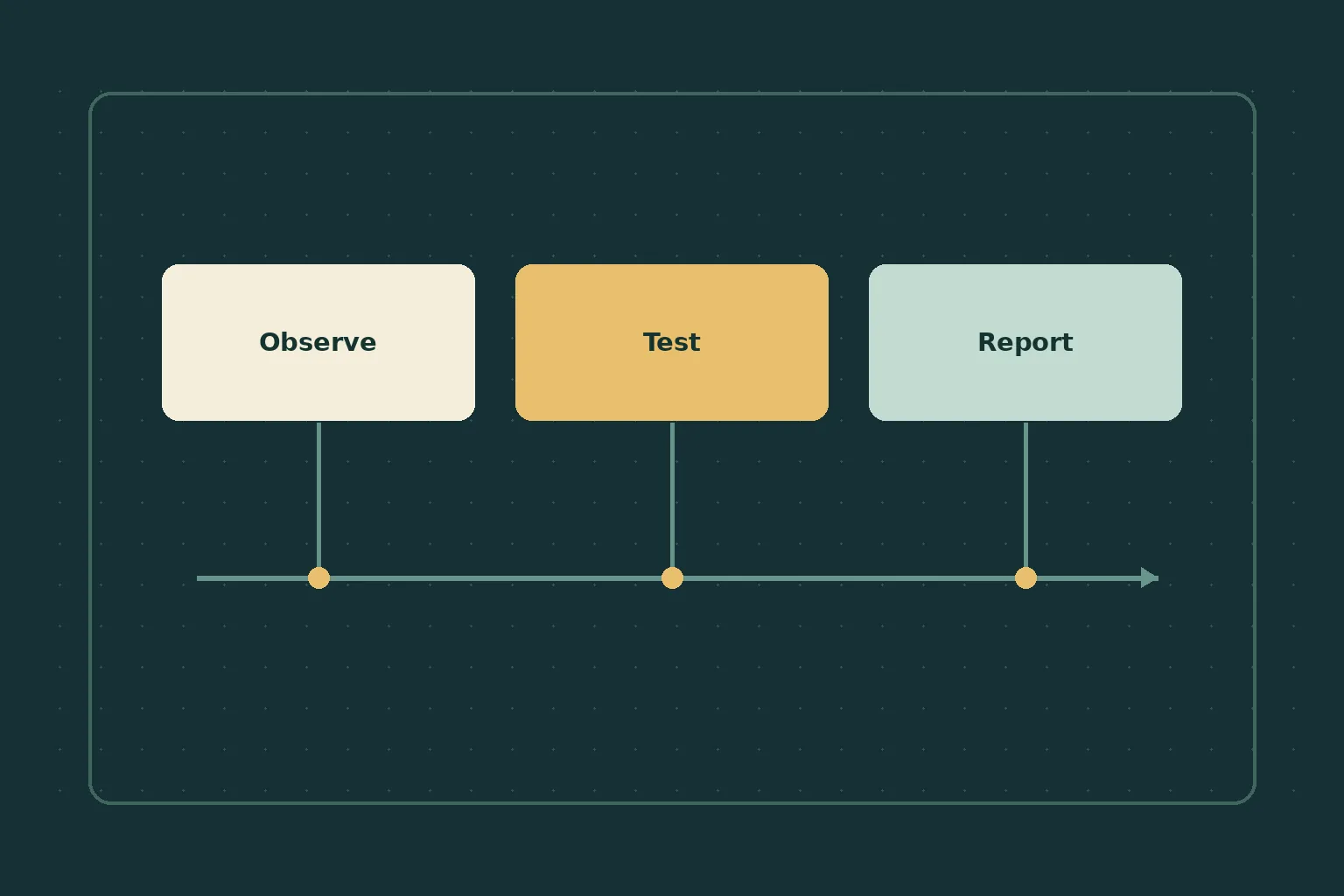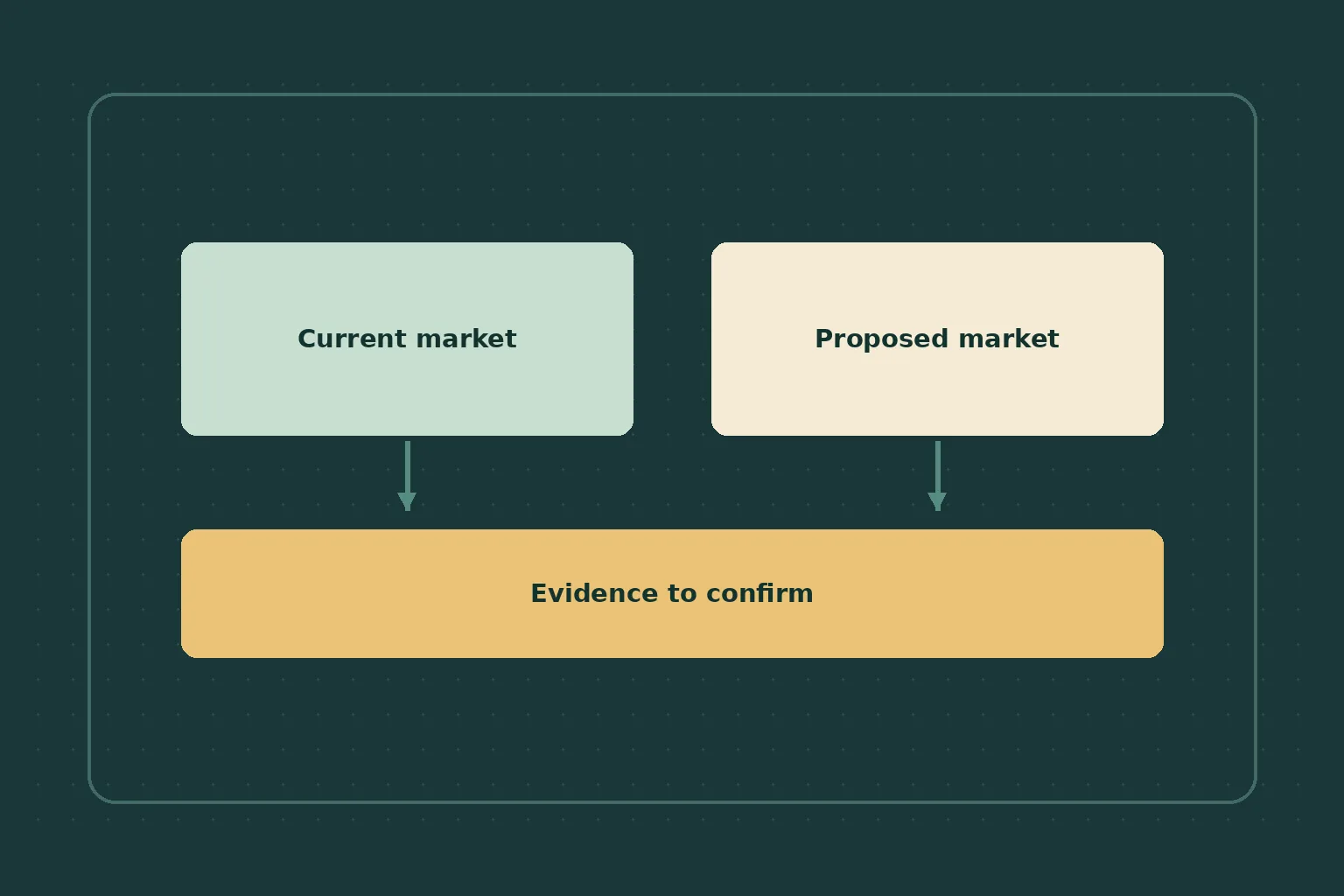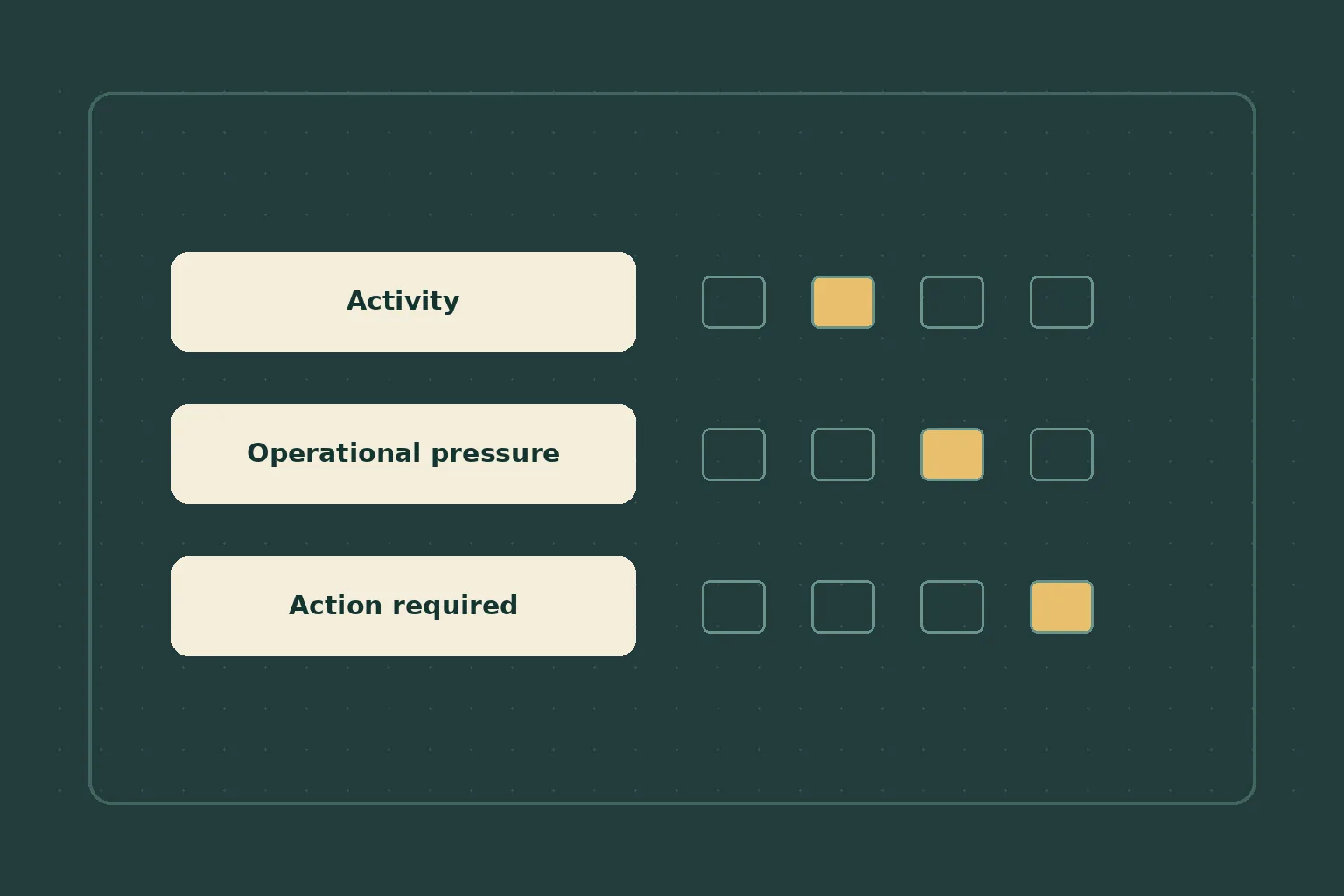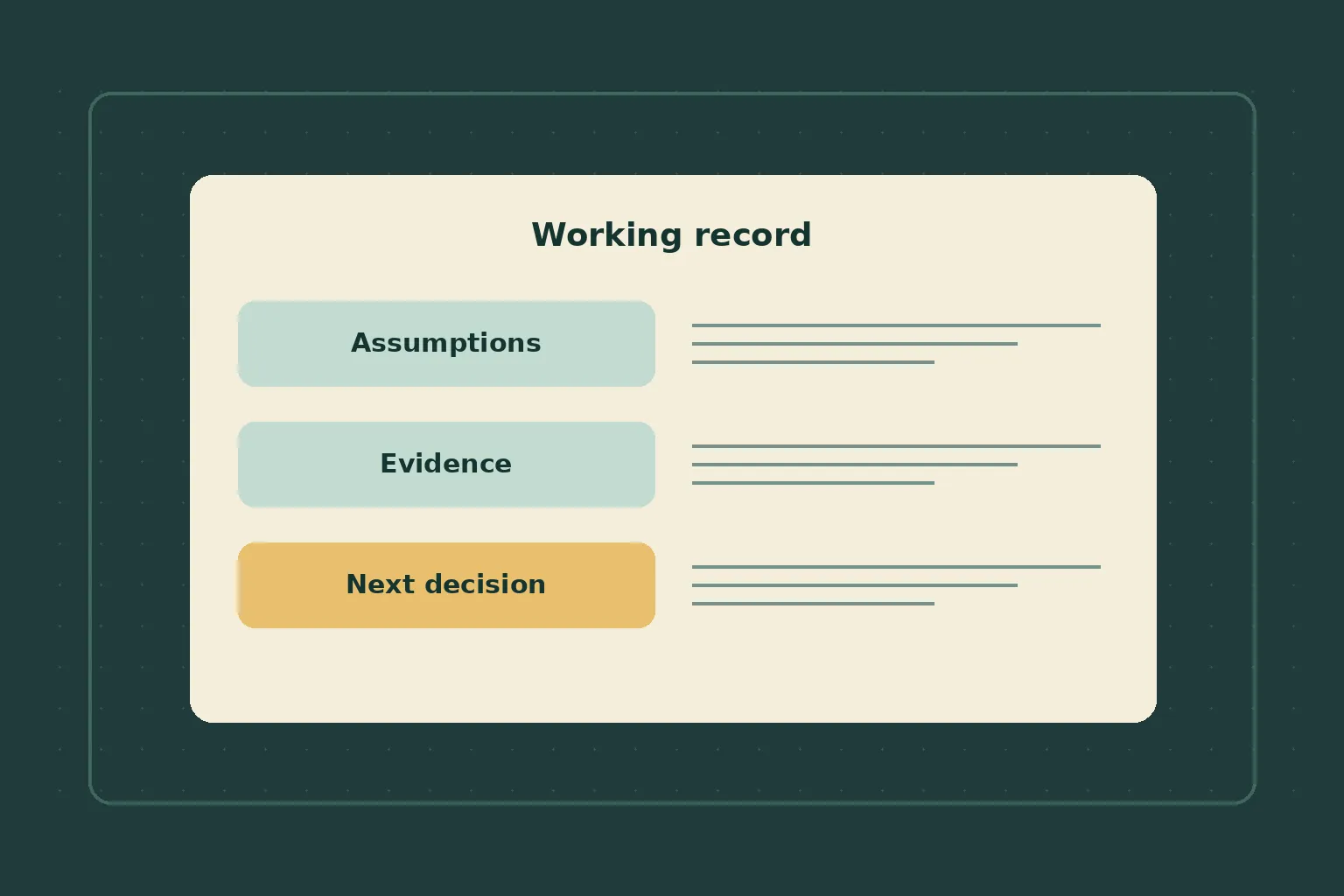
A leadership team can agree that a proposed service line deserves study and still disagree about whether it is ready for a larger commitment. A useful go/no-go memo identifies the exact choice on the table. It gives the decision owner enough evidence to authorize a bounded next step, defer that step, or stop the proposal for now. Each option should be possible to explain without relying on the presentation that accompanied the memo.
Use the memo for the internal business decision about whether to proceed with a defined stage of work. Begin with the practical difference the decision would make. If the team would gather scheduling information and test an administrative workflow, say that. If work outside that study remains outside the decision, name the commitments readers could otherwise infer. The fictional example here concerns evaluating a proposed outpatient service line using shared program resources.
Start with the smallest decision that needs authority
An opening line might read, “Authorize operations to assess whether the proposed service line can share existing program resources before November 30.” This describes a particular decision, a responsible group, and a time by which new evidence can come back. Add the concrete outputs. For example, require a comparison of existing room commitments, a written statement of the proposed workflow, and a list of decision questions that remain open.
Place boundaries immediately below the request. In the fictional example, the team can review existing schedules and run an internal tabletop exercise. The decision leaves external announcements, public opening dates, and changes to current service commitments outside this stage. Naming a boundary is especially important when a project title sounds larger than the actual authorization. A staff member who hears “service line approved” may interpret the title as permission to prepare public materials.
Name the person or body that can authorize the requested action. Name another person to own the work and bring evidence back. These roles can be held by different people. When a committee receives the memo, record whose decision closes the stage and when the committee plans to review the result. Teams considering service line expansion and diversification can use this opening to make a long discussion about possibilities resolve into one actionable question.
Separate what the team knows from what it expects
Evidence establishes an observation within a scope and period. An assumption states what the proposal needs to be true. “The room schedule shows a vacant block on Tuesdays this month” is an observation. “That block will stay available during the proposed evaluation period” is an assumption unless the resource owner can substantiate it. A useful memo makes that gap visible where the reviewer is making the decision.
| Decision question | Evidence in hand for a fictional proposal | Remaining assumption or check |
|---|---|---|
| What prompted the proposal? | Operations recorded several requests for information about a different scheduling option | Decide whether those observations justify studying this particular proposal |
| Which shared work could be affected? | A dated schedule lists existing program uses of the proposed room | Confirm whether the resource stays available across the evaluation period |
| What administrative work would change? | The team has mapped how existing inquiries reach the admissions queue | Test how a simulated inquiry for the proposal would reach the responsible team |
| Who can act on the next step? | The organization has named a decision owner and a work owner | Confirm whether the requested step falls within the stated decision authority |
| What would send this back for review? | The team has agreed which outcomes it needs to observe during the study | Identify any unresolved condition that would prevent work beyond the study |
Add the source and date for each factual input. When someone says the proposal is “in demand,” look for a narrower claim the evidence supports. An internal note may document the kinds of questions people asked. It may say little about the scale or stability of interest. Give the reviewer the observation and the uncertainty. A team can decide to investigate the latter without treating it as settled.
Explain what kind of result would change the current recommendation. For the room example, two weeks of conflicting bookings might make the shared-resource assumption unusable. An isolated exception could instead be something the resource owner can resolve. The memo can record which evidence the person with authority wants to see and what it means for the next choice. The startup feasibility and market analysis context can help a planning team place uncertain inputs in an evidence review while keeping this memo focused on the current internal decision.
Define the choices as outcomes
Go to the defined next stage means the memo’s named work may start under its stated authority and boundaries. Record the work owner, the authorized outputs, and the review date. If the go decision includes a condition, explain whether the owner can start any tasks while it is open. A reviewer can authorize preparation for an internal exercise while withholding the exercise itself until its scope is confirmed.
Hold with a clear review trigger keeps the next stage open for a later decision. State what would allow reconsideration and who will obtain it. “Hold until the room owner confirms the exact weeks available, then return to the decision owner” creates a path back. If the proposed review date arrives with the same condition unresolved, record whether it stays on hold and when the organization will check again.
No-go for the current proposal closes the specific decision. Include the assumption that failed, the evidence that made it untenable, or the reason the team could not identify an appropriate next step. A future team might reopen the idea with a different operating assumption. The memo should retain enough context to explain that a new proposal would need to be considered on its own evidence.
Make the decision and its scope easy to find when the meeting ends. An owner reading a short note should know whether a go vote covered the study, the implementation, or some other explicitly defined action. A meeting record that preserves only a green status can hide meaningful limits. Executive leadership advisory provides related context when leadership needs a clear handoff between a decision and the people authorized to act on it.
Make the next stage reversible
A bounded stage has a stop point. Name the work that can end cleanly, the result the team will bring back, and which commitments are reserved for another decision. In the fictional study, the coordinator can close the internal exercise after delivering a readout. The existing schedule remains the working schedule throughout the study. An exercise outcome that changes assumptions can then prompt review without forcing staff to reverse a public promise.
Think through what would be difficult to undo. A draft plan held within the project is usually straightforward to revise. A roster used by several teams can start producing operational expectations even before anything appears publicly. If completing a work item would create expectations beyond the study, ask for a new decision before treating the item as authorized. An owner may need a narrower way to answer the evidence question.
Define an early stop condition. Suppose the study assumes the existing queue can support a new routing rule without affecting current assignments. If the simulated rule changes how an existing item is handled, the work owner can stop that portion of the test, document the finding, and return it to the decision owner. The rest of the study can continue where the memo permits it. State what the work owner should preserve about the evidence so a reviewer can understand why the test stopped.
Write a brief recommendation that can be challenged
For the fictional proposal, the work owner recommends going ahead with a limited feasibility study, conditional on the resource owner confirming access for the exercise. The evidence supports a reason to learn more, while the availability and routing assumptions remain untested. Leadership can authorize the specific study, hold it until the resource question is resolved, or decline it if even the study would displace current work.
Give reviewers one alternative that addresses the same uncertainty. Instead of using a live room for the exercise, the owner might use a tabletop walkthrough and limit the result to a description of the administrative process. Record what that option can establish. A tabletop can show who recognizes a queue item and who owns the next step. It leaves room availability unresolved. That distinction lets leadership choose a small test that matches the question without overreading the resulting evidence.
If someone raises a concern during review, write it as a checkable question. “We may not be ready” gives the work owner little to do. “Verify whether the new queue item can be distinguished from existing items without changing current assignments” suggests an exercise and an observable outcome. Even if no immediate answer is available, the memo now explains what determines the next discussion.
Show what would change the next decision
Use the final study readout to compare what the team actually observed with the assumptions in the memo. For each material assumption, state whether the new evidence supports it for the period tested, contradicts it, or leaves it open. These states tell leadership where the original recommendation still holds. A study that confirms the routing sequence during one exercise has shown something useful. It has yet to establish that the proposed schedule can use the shared room.
Leave room for an alternative recommendation if the assumptions shift. Suppose the exercise shows that the team recognizes the new type of inquiry but cannot assign it in the current queue. The owner could recommend holding the stage until the team can test a clearly defined routing change. Frame the new request around that narrow question. The memo should let readers identify which conclusion came from the evidence and which option leadership still has to choose.
Send the disposition to the owners who need it
After the decision, record its date, the decision owner, the scope authorized, conditions, and the next review. Identify the people who need the result to do their part of the work. Someone who maintains a shared project plan may need to update the status of the study. Someone who owns existing schedules may need to verify only whether the exercise affects a working resource. Each recipient should be able to identify what they own and what remains undecided.
If the stage goes ahead, put the authorized outputs in the working plan with the original memo reference. When the work comes back, show which assumptions were tested and what the team learned. A choice to continue may require a new memo because the requested action is different. A choice to hold may require only a dated update with a new verification trigger. Teams using ongoing consulting and implementation support can carry the same decision reference into follow-up work without rewriting the earlier disposition.
Before filing the memo, have a colleague who missed the meeting answer three questions. What work may begin today? What finding would stop it or send it back for review? Who decides whether it moves beyond this stage? If the answers vary depending on which page they read, revise the opening and the disposition until they agree. The finished memo should give the organization a clear decision it can act on and a defined point at which that authority ends.