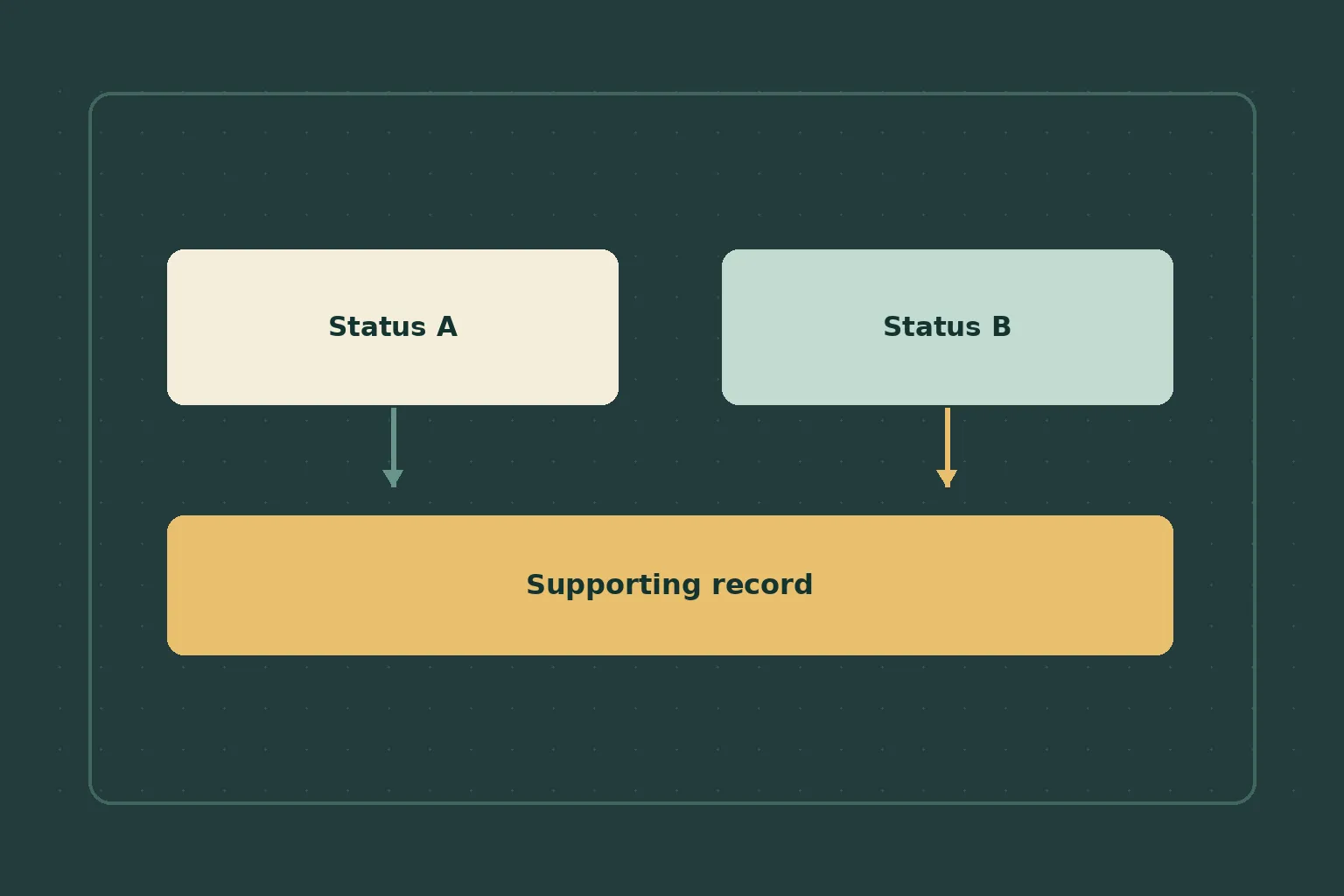
Two internal views can show different statuses for the same administrative task. One may show that the sender finished their part. The other may show that the receiving team still has work to do. Before asking either team to reconcile the labels, decide which event the organization needs to verify and who can confirm it.
The examples below describe fictional internal work items. The sample identifiers refer to made-up office tasks, and the “sender view” and “receiver view” are tabletop examples. Use the exercise to discuss ownership and label meanings within the existing administrative workflow.
Start with the decision the status is supposed to support
Imagine an operations coordinator preparing an internal report about printed materials for a staff orientation. The sender’s view lists the fictional request EX-018 as complete. The receiving view lists EX-018 as pending. A supervisor wants to know whether the expected packet has a responsible owner on the receiving team.
That question is more precise than asking which status is correct. The sender’s complete label may indicate that the packet request left the sender’s work list. The receiver’s pending label may indicate that someone still needs to accept it. Both labels describe plausible events in a hypothetical workflow. The reporting question requires evidence of who took the next action after the send.
Write the administrative question as one sentence. For example: “Has the orientation materials request been accepted by the team responsible for assembling the packet?” Include the action the status will support: sending an internal reminder, reporting an open item, or closing a task. If several decisions depend on the same field, identify the one that matters for the discrepancy under review. A status useful for one decision can be insufficient for another.
Alliance’s EMR and CRM workflow optimization overview describes how responsibilities and handoffs can affect what a system view tells its users. For a status dispute, start by identifying the business question each view can answer.
Describe the events behind the two labels
Ask the owners of the two administrative steps to describe what has happened when their teams use “complete” and “pending.” Then ask what evidence shows that the next event has happened. Put the answers side by side. This separates the displayed wording from the events the wording represents.
| Event | Sample evidence used in discussion | Administrative question it can answer |
|---|---|---|
| Request prepared | The fictional task card has a scope and due date | Is the request ready to send? |
| Request sent | The sending team confirms it released the request | Did the sending team complete its step? |
| Request received | The receiving team can identify the request in its work list | Did the request reach the intended destination? |
| Request accepted | A named receiving role confirms responsibility | Who owns the next action? |
| Work finished | The owner confirms the packet is ready and states the disposition | Is the assigned administrative work complete? |
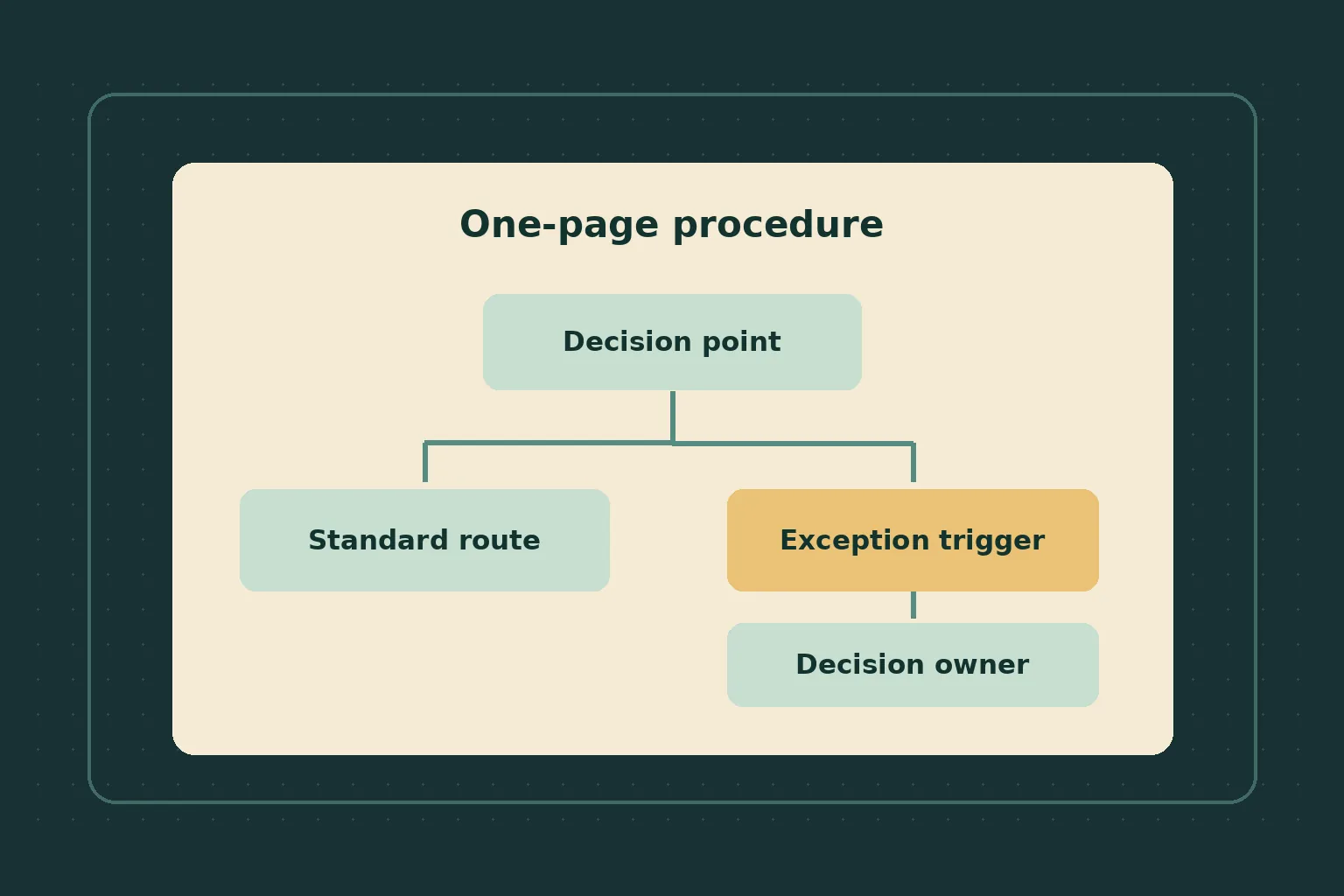
Teams sometimes use “received” and “accepted” interchangeably. Ask them to name the difference using the sample. In this example, “received” means the request became visible to the receiving team, while “accepted” means that a named role took responsibility. A weekly report about ownership needs the second answer. A review of whether requests reach the correct destination may only need the first.
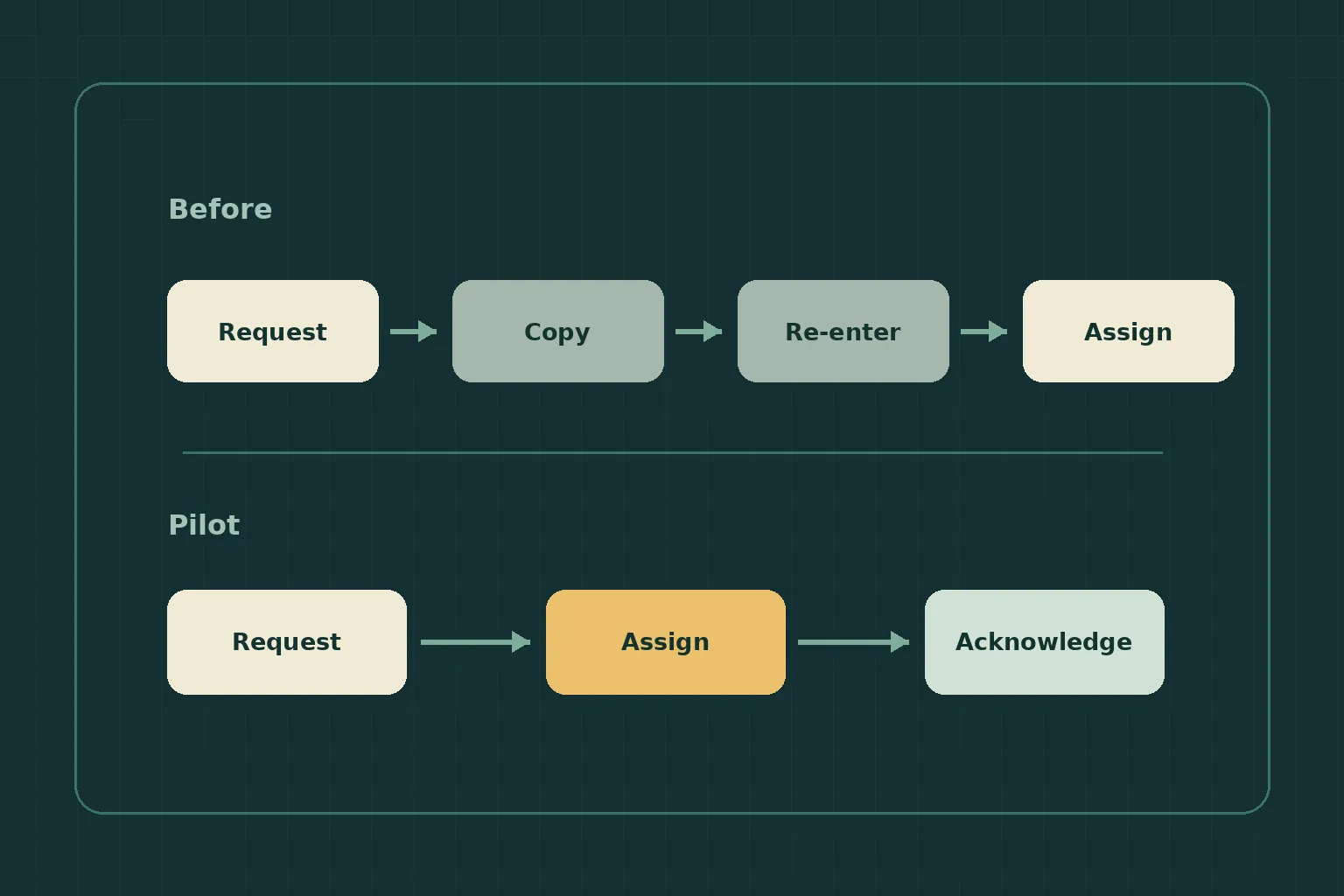
There is also a useful difference between a disagreement and an expected sequence. A sender can mark the send step complete in the morning and a receiving owner can accept the request later. During that interval, the values may differ by design. For the reporting question, confirm what remains open and whether the interval fits the team’s existing review practice. That tells you whether to wait, assign follow-up, or ask the owners to clarify the definitions.
Alliance’s cross-department communication and coordination page discusses responsibilities when work passes between teams. Naming the boundary between sending and acceptance gives the two teams a concrete handoff to examine.
Choose the source for the question
When the question is “Who accepted this work?” use the source the organization has designated for receiving ownership and the owner who can interpret it. When the question is “Did the sender submit the request?” the designated sender record may answer it. A source should have an accountable owner and evidence for the event being checked.
Write a short reference for the decision under review. Include the requested event, its designated source, the role accountable for confirming it, and what would count as confirmation. For EX-018, the note could say: “Question: did the receiving team accept orientation materials? Basis: confirmation from the receiving work owner. Evidence: the role responsible for assembly and the next action.”
Timestamps help describe the sequence. Suppose the sender view was updated at ten, and the receiver view was read at eleven. The order tells you when the values were observed. It does not tell you who owns the work. Keep the time beside the observation so the next person can tell whether later information reflects an actual decision or simply a more recent display.
A useful reference also says what to report when the information is unavailable. In the fictional report, “acceptance unconfirmed” is more precise than a guess of either complete or incomplete. The reviewer can still say that the sender released the request if that event is supported. Use separate statements when one event is known and the next one remains open.
Work through three fictional discrepancies
With EX-018, the sender marks the request complete after sending it. The receiving team can see the request, but its lead has not assigned assembly. The answer to the ownership question is “acceptance unconfirmed.” The receiving work owner takes the follow-up to identify who will assemble it. The sending team’s complete status can still describe the send event.
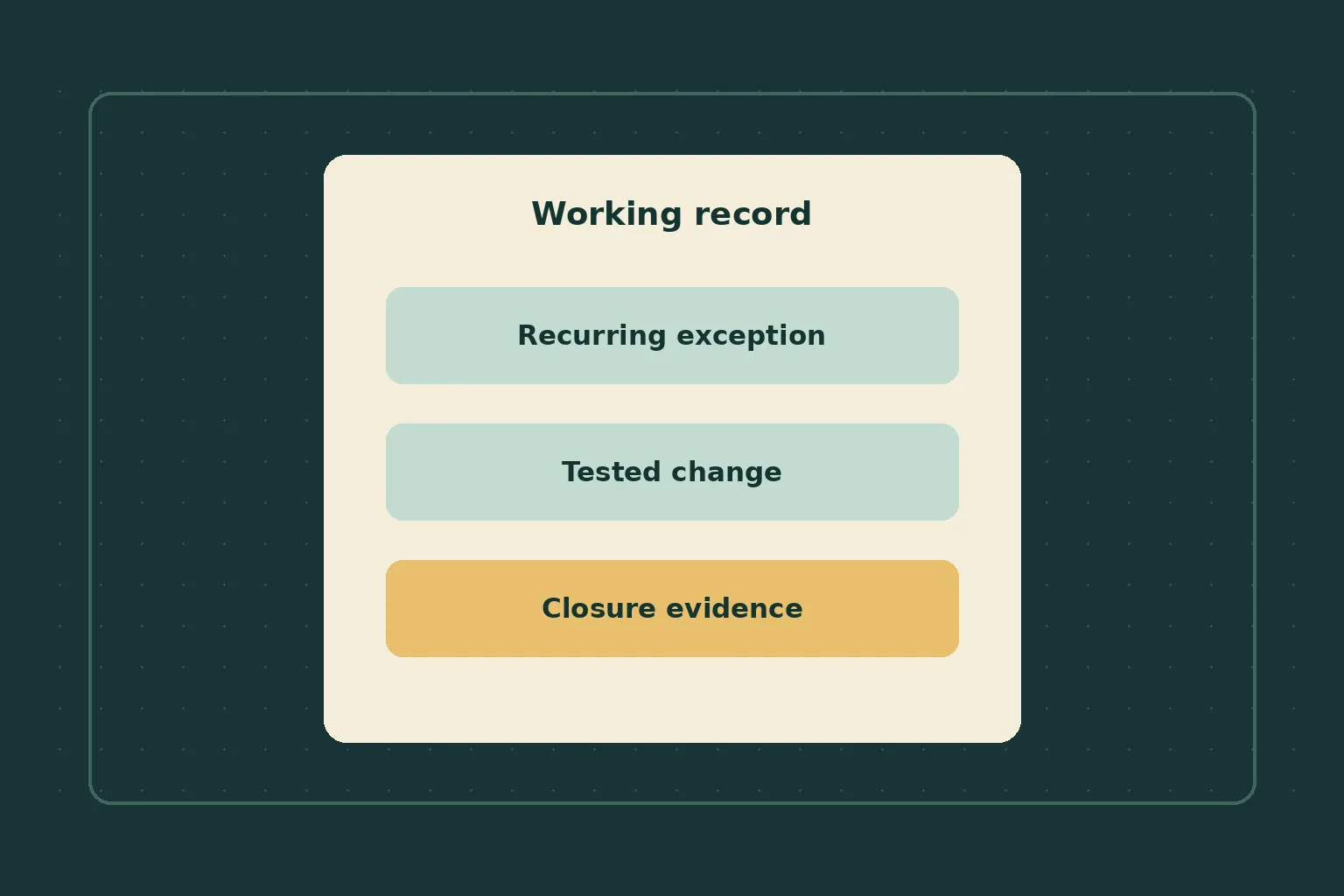
In EX-026, both teams say that “complete” means the receiving work finished. One view says complete, and the owner of the receiving work says the packet remains unfinished. Because the teams are talking about the same event, ask the designated workflow owner to resolve the contradiction under the organization’s existing procedure. The next internal report can show that closure is awaiting confirmation. That preserves the question while the people responsible for the underlying work check it.
In EX-031, the receiver confirms that someone accepted the request. The reporting note still shows “pending” because the previous reviewer wrote it before the acceptance occurred. The note and the new confirmation describe different points in time. In the next review, use the dated confirmation to explain the sequence and identify the current owner. The review should still distinguish the fact that the owner accepted the work from whether the work was finished.
These examples give a manager three types of discussion to practice. In the first, the labels describe different events. In the second, the same event has contradictory accounts. In the third, a later event explains the difference. An open question in one category may need a very different owner and next action from an open question in another.
Give the follow-up a clear owner and return point
A task to ask about the discrepancy should identify who will follow it, who can answer it, and when a dated update is expected. In an exercise, you could write: “For EX-018, the operations coordinator will ask the receiving work owner whether the request was accepted and check the response at the scheduled afternoon review.” A note such as “check status” leaves the question and the authority implicit.
Separate the owner of the follow-up from the owner of the decision when they differ. A coordinator may collect the observations and ask for clarification. The receiving work owner may be the person who can confirm acceptance. An operations supervisor can resolve a dispute about which definition the team should use. One person can hold several roles, but the assignment should say which role is responsible for which action.
When the designated owner is unavailable, use the backup or supervisor already identified for routine administrative decisions. If the backup can gather facts but cannot confirm closure, keep the item open under the appropriate authority. Agree on who will check the response and where the answer will be reflected in the next administrative review. Alliance’s leadership and management consulting overview describes the role of clear management responsibilities in following operational work through.
Keep the report bounded to the decision it supports. For example, if a manager asked whether materials assembly has an owner, report that answer with the date and next action. A second question about when the packet will be distributed belongs with the role that can confirm the schedule. Resolving one status question may expose another without answering it.
Agree on one wording for repeated reviews
If teams keep bringing the same mismatch to their regular review, agree on the words to use when reporting the relevant event. A short reference might define sent as released by the sender, accepted as owned by a named receiving role, and finished as disposition verified by the receiving owner.
Have the two roles read those definitions against a fresh fictional item. Ask the sender what they can confirm, then ask the receiver what they can confirm. A reviewer should be able to explain why a send can be complete while the handoff is still open. If either person sees a different meaning, revise the administrative reference before asking others to follow it.
Try one further scenario where both owners are available but one answer is unverified. Ask the reviewer to state the available fact and the open question in two sentences. For example: “The request was sent. Acceptance is still awaiting confirmation from the receiving owner.” The exercise gives the team language it can use when a meeting asks for a simple yes or no that the evidence cannot yet support.
Alliance’s operational consulting and performance improvement page describes how recurring administrative barriers can be examined alongside department roles and management routines. Here the useful deliverable is a shared interpretation the owners can apply to a fictional sample and then use in the normal business review.
Close the discrepancy when the original question has an answer
Return to the question you wrote at the start. If it asked who accepted the request, close that follow-up after the accountable role confirms the owner and next action. If the question asked whether the packet was complete, check for confirmation of the disposition. A reply that a message was received can be useful at either stage, but it only answers the receipt question.
For the fictional EX-018, the closure note could read: “Receiving work owner confirmed the assembly assignment at the afternoon review. The materials coordinator owns assembly and will provide the next update on Thursday.” Record a completion decision separately if and when it occurs. That leaves the next reader with a clear answer about the handoff and a clear expectation about the work still ahead.
If the organization cannot identify the role authorized to answer the original question, record the unresolved ownership question and direct it to the appropriate management owner. That outcome supplies useful evidence about where the workflow needs clarification. The immediate goal remains the same: make an administrative decision from a named event, a responsible source, and an answer another staff member can verify.