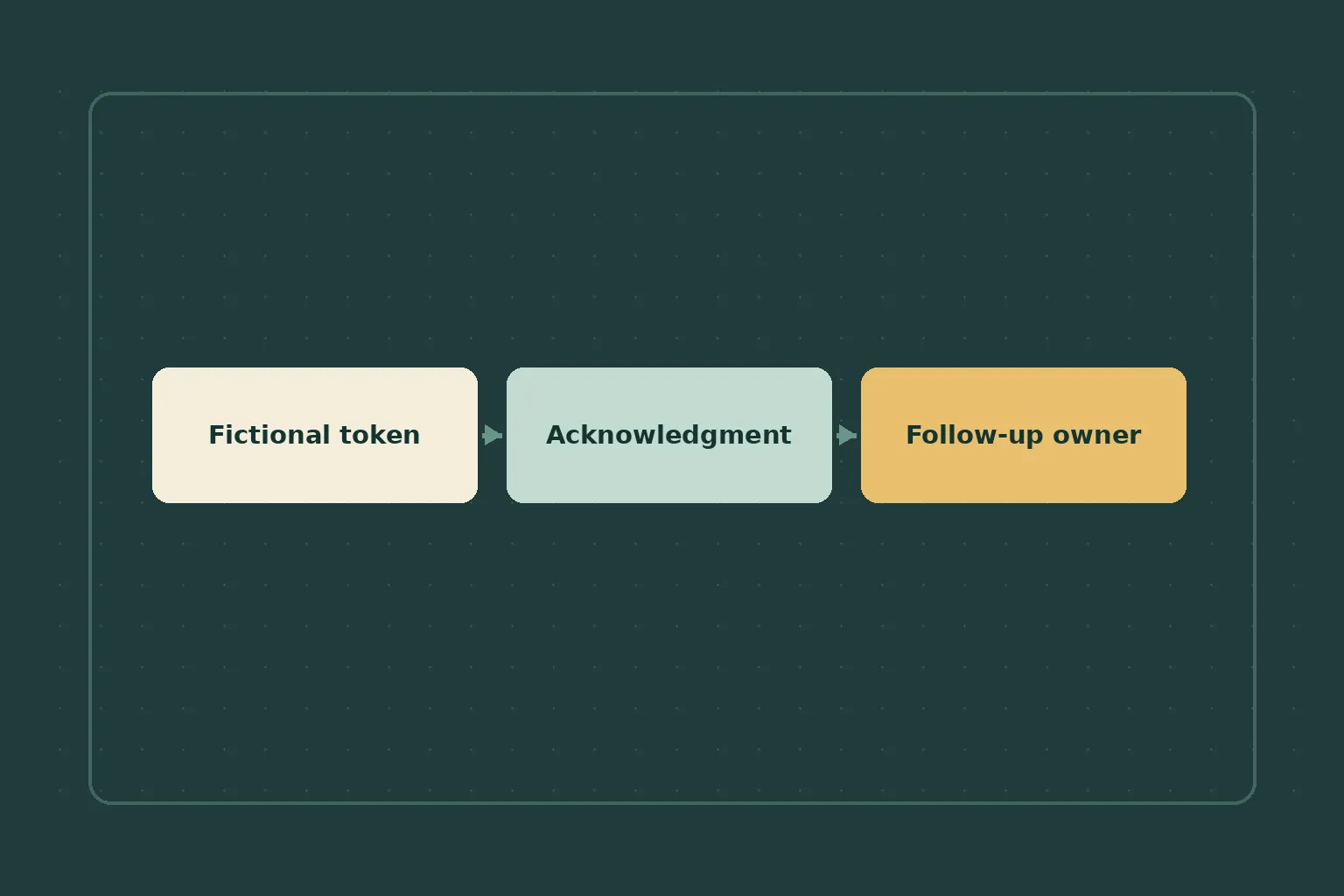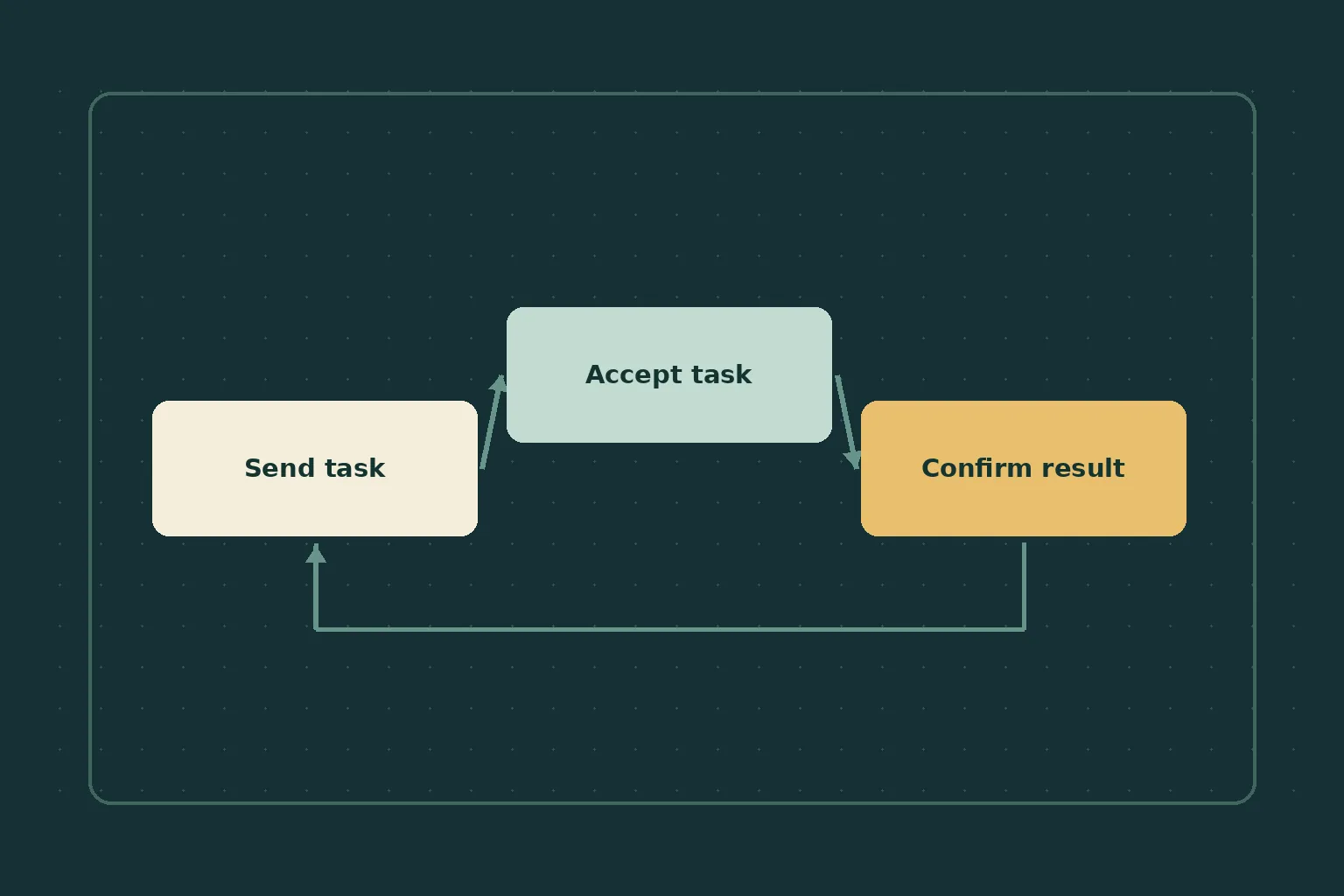
An administrative referral task is easy to mark as received. Closing the loop takes three visible steps. The task reaches the intended route, a receiving department acknowledges that it owns the review, and someone accepts a concrete next action with a due time. If the sender cannot see where the task stands, both teams can believe they have done their part while the actual question is still open.
Start by choosing one ordinary internal task to trace. A behavioral health outreach team might ask operations to confirm which department maintains an approved set of general referral instructions. The job is to resolve a business routing question. Use an invented example in a review meeting and map what each team would see. A simple test can expose a missing responsibility before you rewrite a procedure or change the whole queue.
Map where accountability changes hands
Define receipt, acknowledgment, and next action assignment as separate events. Receipt tells the sender that the task reached the expected route. Acknowledgment tells the sender that the intended department has taken responsibility for the administrative review or has returned it for a stated reason. Assignment tells both sides which role will do the next identified piece of work and when they will review or complete it.
Choose evidence staff can see within the approved internal workflow. A shared status can work if both roles know where to view it and who controls the transition. A queue supervisor might be accountable for acknowledgment during staffed hours, while a workflow owner takes the next action. Name these as separate responsibilities even if the same person covers both. Then map who still owns the follow-up if the task gets returned or if the department does not acknowledge it.
| Transition | What the sender can observe | Role accountable at that point |
|---|---|---|
| Received | The task appears at the agreed internal destination | Role assigned to monitor the destination |
| Acknowledged | The receiving department records ownership of the review or returns it with a reason | Receiving queue owner or designated backup |
| Next action accepted | A named role accepts an observable action and a due time | Person responsible for the action |
| Closed or escalated | A resolution or a new accountable owner and review time are visible | Person who held the action until the transfer or closure |
Look for a transition that exists only in conversation. Staff may say their team “gets” the tasks even though it is unclear whether anyone is expected to acknowledge each one. Ask both departments to show the same transition on their own views. Alliance’s cross-department communication and coordination is relevant when departments need to define what each team owns and what it can see.
Reconstruct the first missing event in one example
In a fictional organization, an outreach coordinator submits a task for an operations reviewer to check a business routing instruction. The central queue records the item on Monday. The coordinator sees “received” and assumes it now belongs to operations. The operations reviewer works from a filtered queue and sees only items assigned to a designated group. Nobody has made that assignment, so nobody accepts the review.
Walk through the events in order. The coordinator completed the sending step and the internal destination posted receipt. The receiving department neither accepted nor returned the work. There was no next owner or due time. The first failure sits at acknowledgment. Changing how fast the central queue marks receipt would leave that failure intact. A better test is to require the applicable receiving role to accept or return the item and let the sender see the result within the existing workflow.
Ask why acknowledgment did not happen before adding another notification. Perhaps the chosen destination collects tasks but leaves the next team blank. Perhaps a supervisor assigns work twice a week and nobody knows who monitors items in between. Perhaps the label on the receiving view suggests someone has already accepted it. Each explanation has a different correction. One may require assigning a staffed route, another may need a review rule, and another may be fixed by changing an ambiguous label.
Write down the failed event as an observable fact. “Operations did not see this in its assigned view” is easier to fix than “communication was poor.” Compare what the sending and receiving roles saw at each point. Teams reviewing similar process gaps across department boundaries can consider Alliance’s workflow development and process improvement.
Give the receiving department a way to accept or return work
A useful acknowledgment establishes whether the department can take responsibility, even if it needs more time to resolve the business question. The receiving role can accept the review and identify who should act next, or it can return the task with a brief reason and an observable next step. Examples of internal reasons might include a wrong destination, an unclear organizational question, or an action that belongs to another department.
Decide which role owns a returned task. If the originating team submitted it to the wrong operational group, that team can remain responsible for rerouting until another role accepts it. If the receiving role is authorized to reassign it directly, it can use the existing workflow to identify the right destination. In either case, the sender needs to know whether they should act or wait for another acknowledgment. A status that says only “returned” leaves that responsibility open.
For an accepted item, keep the next action narrow. An example is “Verify which department owns the general inquiry route and record the current contact wording by the internal review date.” The assigned role has a step it can complete, and the sender knows what to expect. The acknowledgment covers responsibility for the business task. Any broader decisions stay with the roles designated in the organization’s established process.
If a receiving role has no backup, tell staff how to handle the time it is unavailable. A temporary queue owner can acknowledge the task and advance it when authorized, or a manager can choose a new route. Agree on how a change in ownership becomes visible to the original sender. Alliance’s admissions process evaluation and optimization describes how teams can examine ownership and delays in workflows that involve an admissions department.
Set an escalation rule that people can use
Write down the trigger and the receiving role together. A team could use the next internal review window as the trigger if acknowledgment is missing, with the queue supervisor responsible for checking the destination. A separate trigger may apply after acknowledgment if a declared due time passes without the next action. That issue belongs with the manager of the assigned task. Distinguish these cases so someone does not send the same problem to both supervisors and assume one has it.
Choose timing around actual staffing and the nature of the business question. A schedule may contain a routine review on the next working day or a different documented check for a scheduled operational change. An internal target should reflect how staff can monitor the route. Publish the cadence in the workflow instructions and give the sending team a way to find it when they are waiting for acknowledgment.
An escalation should have a concise task statement, the last observed event, the decision needed, and the current review time. The person receiving the escalation should know whether to accept the action, reroute it, or return it with an explanation through the approved process. Record any newly responsible role in the same flow. A notification can draw attention to an issue, but the sender needs to see how ownership ended up changing.
Check for competing escalations. If two managers both receive the same task, give one the job of confirming ownership and close or link the duplicate internal action according to the process. If a task goes out to multiple groups for input, keep one accountable next owner and label the other assignments as supporting actions. Alliance’s lead management and follow-up systems offers related context for teams working on clear ownership and follow-through across shared queues.
Test the path from the sending and receiving views
Run the normal path first using a made-up administrative task. Ask the sender to explain when it reached the destination and where they see acknowledgment. Ask the receiving role to accept an action and set a review time. Return to the sending view and ask who owns the next step. Then record a fictional resolution and confirm the sender can distinguish a completed task from an acknowledged one.
Next simulate the wrong destination. The receiving role should be able to return the task with a reason or route it under its existing authority. Ask the sender who owns the action now and how they know. If responsibility remains unclear, the test identifies a gap in the return rule. Change only the affected part of the exercise and rerun it until the next owner is clear.
Then run an unavailable-owner example. Let the acknowledgment check pass without a response. The sender should be able to find which supervisor or staffed role takes the escalation and where that role records the decision. Repeat the exercise with acknowledgment already present but the next action overdue. That second test distinguishes an intake ownership issue from an action completion issue.
Record the expected event, the event you observed, and the role responsible for any correction. For a first test cycle, choose tasks that occur often or cross the highest number of roles. A successful test covers the routes it exercises. Keep a short list of other situations to test when the teams change responsibilities or add another queue.
Review recurring breaks without adding unnecessary steps
In a routine review, bring examples of business tasks where staff had to ask who owned the work. Identify the first missing or ambiguous transition. If several tasks were acknowledged but lacked a named action, review the assignment rule. If several arrived at a route nobody monitored, start with destination ownership. If tasks regularly moved departments without a visible acceptance, examine the rerouting rule.
Pick a correction small enough to try through the existing process. It might be a visible assignment step when accepting a task, an explicit return reason, or a clock that starts when the receiving department has the task. Give the correction an owner and run the applicable fictional example again. Ask the staff who actually send and receive work whether they can see the change in their normal view.
Make closure observable as well. If the task was to verify an organizational contact route, closure might mean that the owner recorded a confirmed answer and the sender can see that the administrative work is done. If the question remains unresolved, record the current owner and next review point. A transfer only ends the sending role’s follow-up when the receiving owner has accepted responsibility under the defined process.
At the end of the review, choose one ordinary task and ask both sides to name its current owner, next action, and escalation point if the action is missed. When they can answer from the workflow they use every day, the agreement is doing its job. When their answers differ, go back to the first event they interpret differently and work from there.